‘St Jude’ Storm – Sad Losses

We are sorry we had problems with the web site over three days, Tuesday to Thursday of this week. We have put it down to glitches in an updated piece of software.

Anyway, we did not escape unscathed from last Monday morning’s storm. One of our largest hybrid Magnolias, ‘Royal Crown’ broke off at about 10 feet up the trunk.
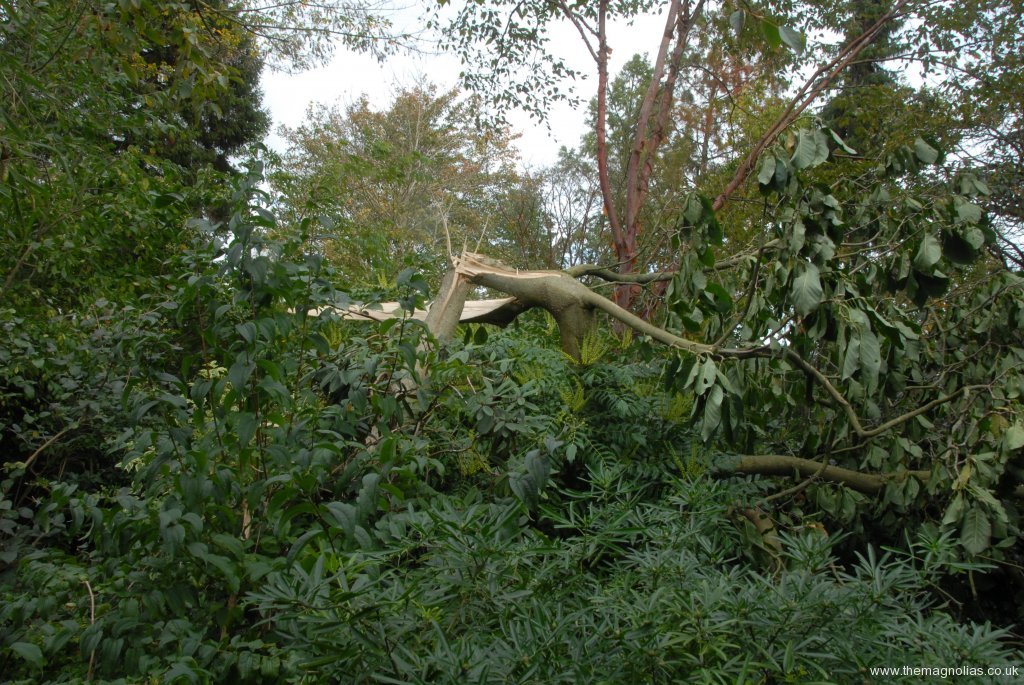
It was quite ironic as we had been saying there were going to be terrific new views of it from the ‘New Summer Garden’ next spring, following the removal of the old climber covered pear trees. The old trees would probably have blown over had they been there, but the Magnolia might have been protected, but we will never know!

It had many hundreds of flower buds and it has been quite sad shredding all the brushwood and cutting up the trunk and branches. However, in our experience with Magnolias, the remaining four foot of undamaged trunk will sprout vigorously next spring, and before too many years have passed we will get flowers again. It may take a while to get back to its previous dimensions of perhaps 30ft high by as much through, which is perhaps not a bad thing! There was some good news about the tree falling, in that not a single shrub underneath it was damaged significantly by its falling. In fact the very minor damage occurred mostly in the clear up, while cutting and dragging off the tree branches from out of a large Mahonia ‘Winter Sun’ and various Camellias and other shrubs.

The other tree blown completely out of the ground was a venerable cooking apple ‘Monarch’, planted by my father in the 1930s.
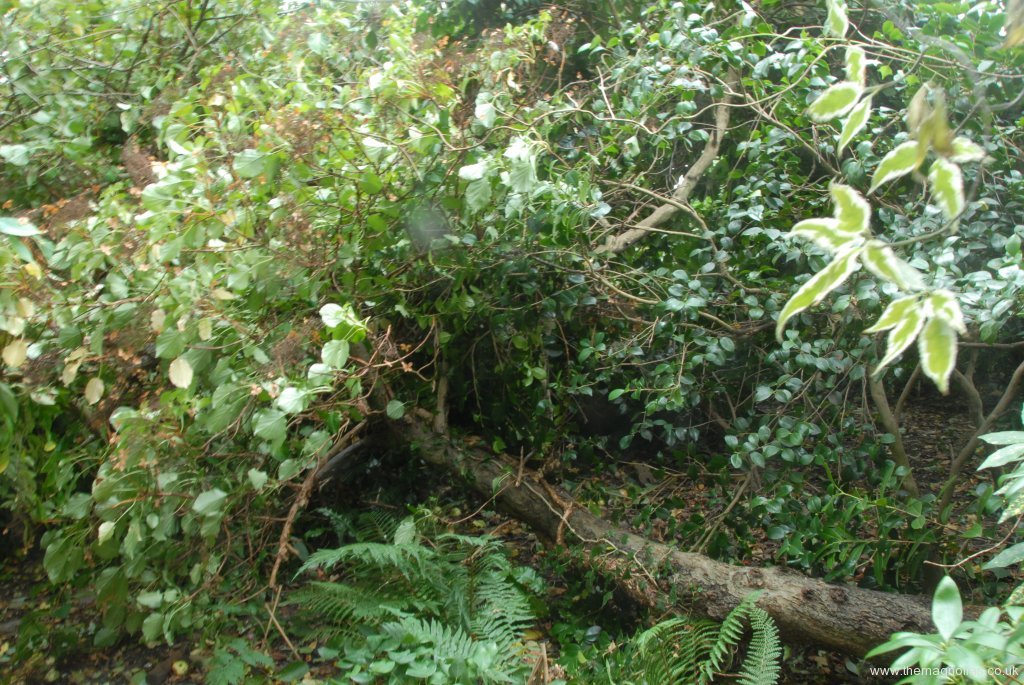
Apparently Monarch was preferred during the Second World War and after while sugar was rationed as less sugar is needed than with the Nation’s favourite cooking apple, ‘Bramley Seedling’. I know we prefer it of the two for flavour. Fortunately a couple of years ago I grafted a scion from it, onto a dwarfing root stock, just in case it were to succumb to disease etc.

The old tree had been covered with a substantial Climbing Hydrangea (H. petiolaris), and no doubt this was a major contributory factor to it being blown down. The hydrangea has come right out of the ground as well. We haven’t finished the clearing up of this one so don’t know the full extent of collateral damage of under planted shrubs but we think it may be worse than the insignificant damage of the bigger tree.

This is not the first tree to have been blown over because of the extra wind resistance of climbing plants supported by them. . A few years ago, we lost a completely healthy Prunus serrula in winter time when it had no leaves because of a large evergreen climber, Stauntonia hexandra which it hosted. The tree had been a fair size with a trunk close to a foot through.
National Collection of Epimedium

We have recently received confirmation from Plant Heritage that we have been given full National Collection status for Epimedium species, cultivars and hybrids.

As visitors to this website have probably guessed we are pretty keen on Epimediums, so earlier this year after discussing with various people whether we should aplply for a National Collection, we decided to approach Plant Heritage. Quite a lot of forms were filled in and a few days spent as we have worked hard, creating accession sheets. These allocate a unique number to each plant derived from a particular source.

Also we have devised a four letter code to identify each source, be it a nursery or an individual, and two numbers indicate year the plant was aquired since 2000. For example 239-Edru-13 (accession number- Edrum Nursery- 2013) The year before 2000 is a bit irrelevent even if we knew them.

We have purchased a Brother label printer which is connected to our PC and prints 36mm wide self adhesive labels which unlike Dymo seem to stick well to the tee labels, we have been using. Our son, Paul set up the printing of the labels so they include our Magnolia logo, which does give the completed label a touch of class. The labels also show the accession number, and source and date codes.

The work in doing the above was quite time consuming but I am already finding it useful to know where a plant came from and when, from the codes on the label.

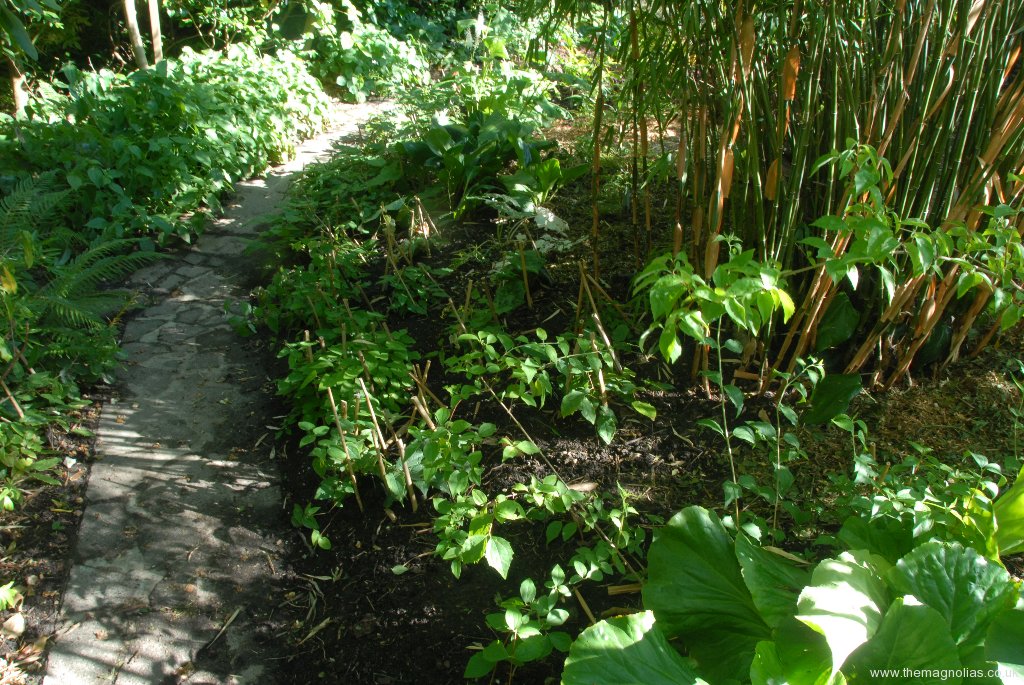
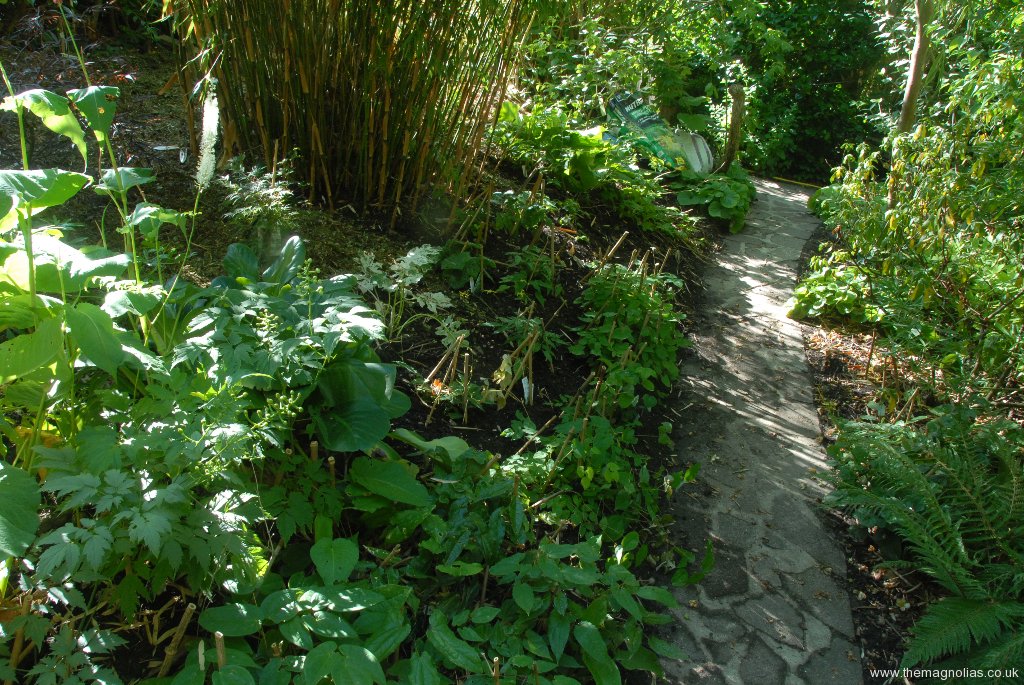
As well as the documentation and labelling works, we have achieved a fair amount with buying quite a few new ones and preparing areas for new Epimedium plantings. Each new plant is protected with four short canes, against badgers digging up the recently planted specimens. This system works remarkably well as badgers regularly dig between the plants without disturbing them.

Plant Heritage like National Collection holders if possible to have more than one specimen of each plant, two growing in the ground and one in a pot. We probably will not manage this with many varieties, due in part to space constraints, but we will try to do this for all the species we can collect. Previously we had few Epimediums in pots, only those growing on to a sufficiently strong specimen to be planted out.

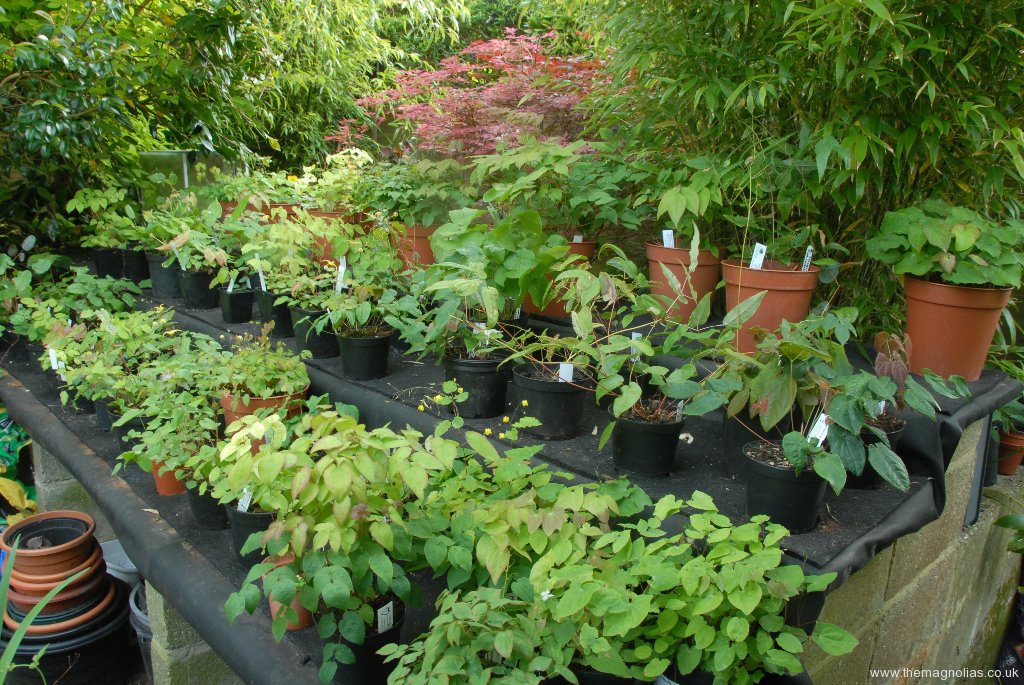
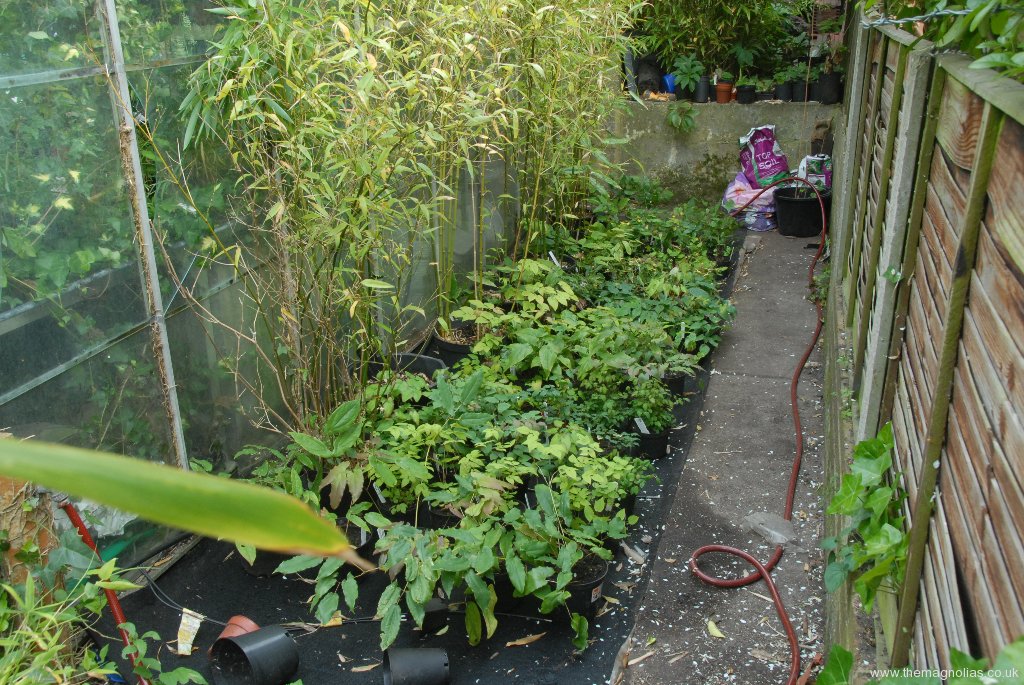
In order to show the potted plants off we have utilised our old plant sales, tiered area. To accomodate more potted specimens we have started clearing a rather neglected area behind our biggest greenhouse.

We would be please to hear from any other keen Epimedium collectors.

Mystery Solved

Since we bought our new garden five and a half years ago there have been constant attempts by either a fox or badger to burrow into a neighbours garden in a bank along the boundary.

After many attemts to fill in the holes we gave in and for a year or more there are just two holes and no further soil has been excavated after the first few barrow loads.

Last week Maplins sent an E-mail offering an ‘Outback Cam’ which takes images in the dark using infra-red when it senses movement. We bought one for a bit of fun, and set it up in front of the holes. We now know who was responsible!

And Then There Was Light

Since suitable weather has been with us, we have been quite busy in the garden. I have taken a host of new pictures, trying to better previous images of some plants, or increasing the galleries with pictures of new species or cultivars. The Epimedium and Magnolia galeries have probably had the most additions.

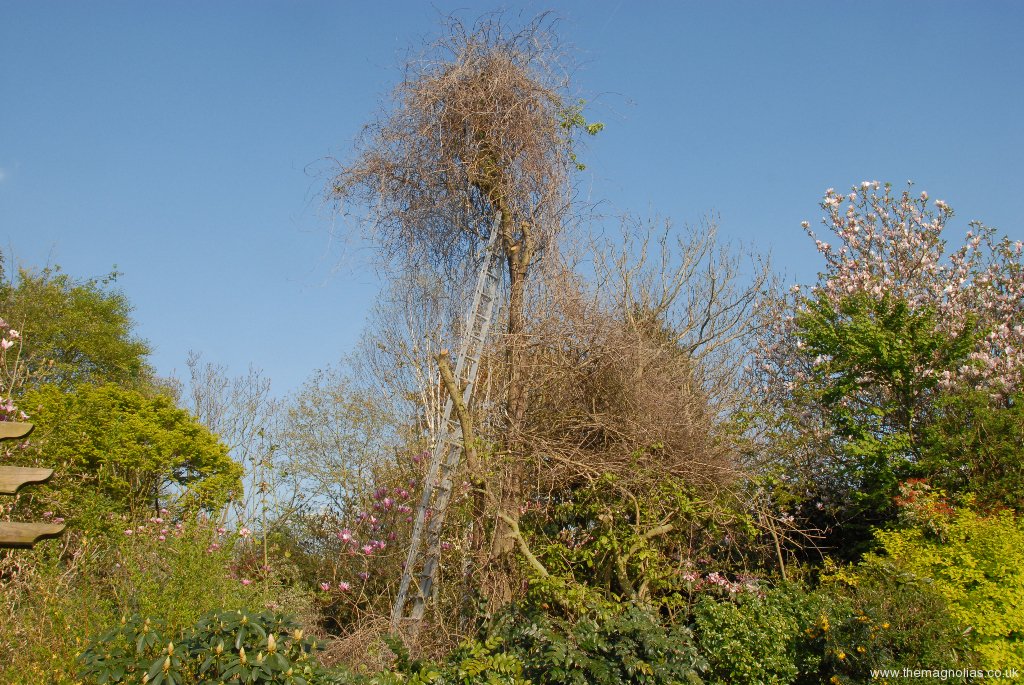
Garden work has been fairly dramatic getting rid of two 1930’s pear trees which had been covered in huge climbers. One of which had been the support for a male Kiwi Fruit and a massive ivy called Hedera colchica ‘Pady’s Pride’ has now gone and the stump dug out and bamboos planted in their place. The ivy had effectively turned the tree into an evergreen pillar ten feet wide and perhaps twenty five feet tall. trying to get hold of adjacent trees.Out of the top of this, Kiwi vines grew out in all directions like a gigantic hydra,

Now we are well on the way through the next pear tree this time covered in Clematis montana and Celastrus scandens. The Celastrus was doing the same as the Kiwi, trying to grapple its way into other trees. Both the climbers have multiple trunks at ground level approaching three inches thick, but they must be around forty years old.

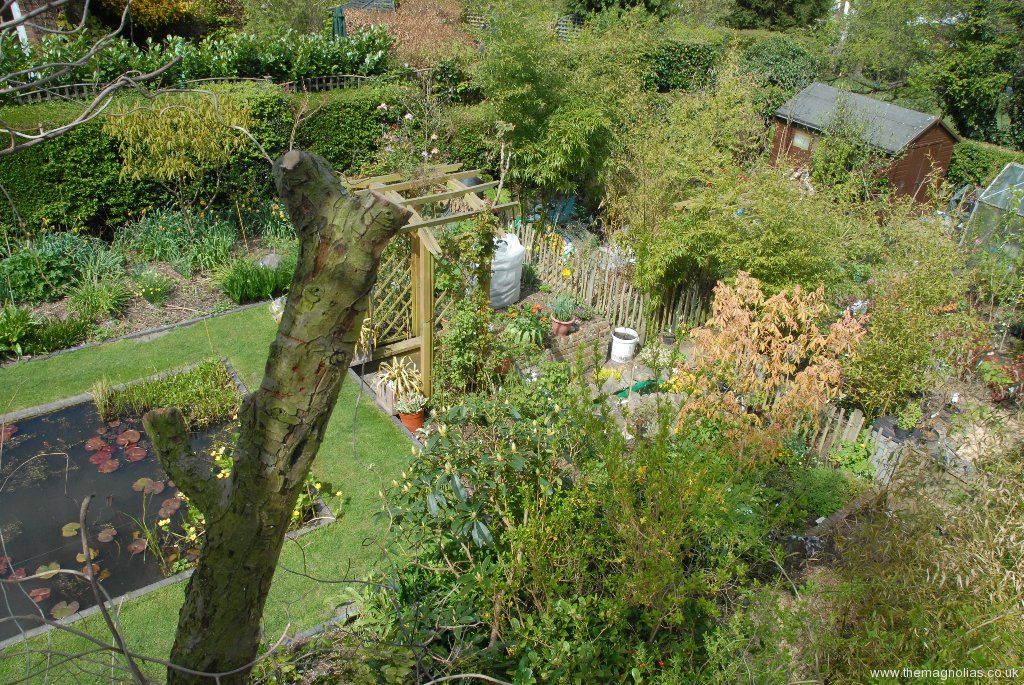
The original reason for removing these trees and climbers was to let sun light in from the East to the new ‘Summer Garden’, but probably the best result is going to be new views of quite a few Magnolias that didn’t exist before. Some new pictures in the Magnolias gallery have been taken from this new direction. It hasn’t been the best of years for them, due to the indifferent weather starting almost a year ago. I have labeled some of the images of Magnolias with 2013, because I don’t think the colours are as rich as usual.

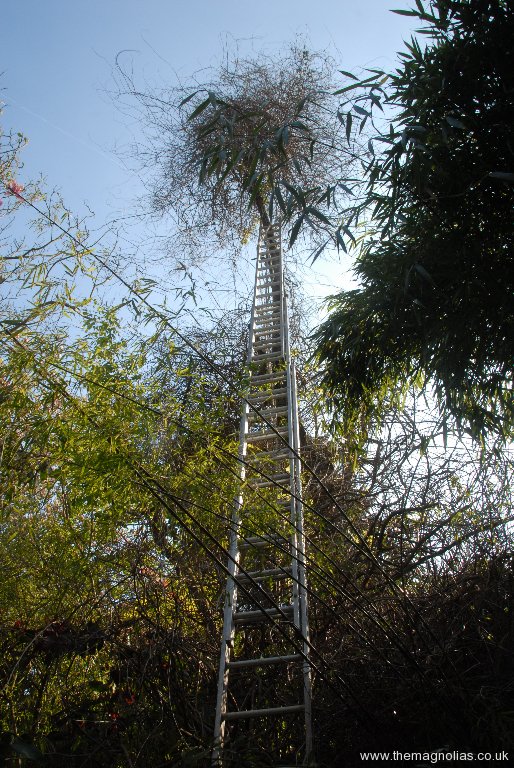
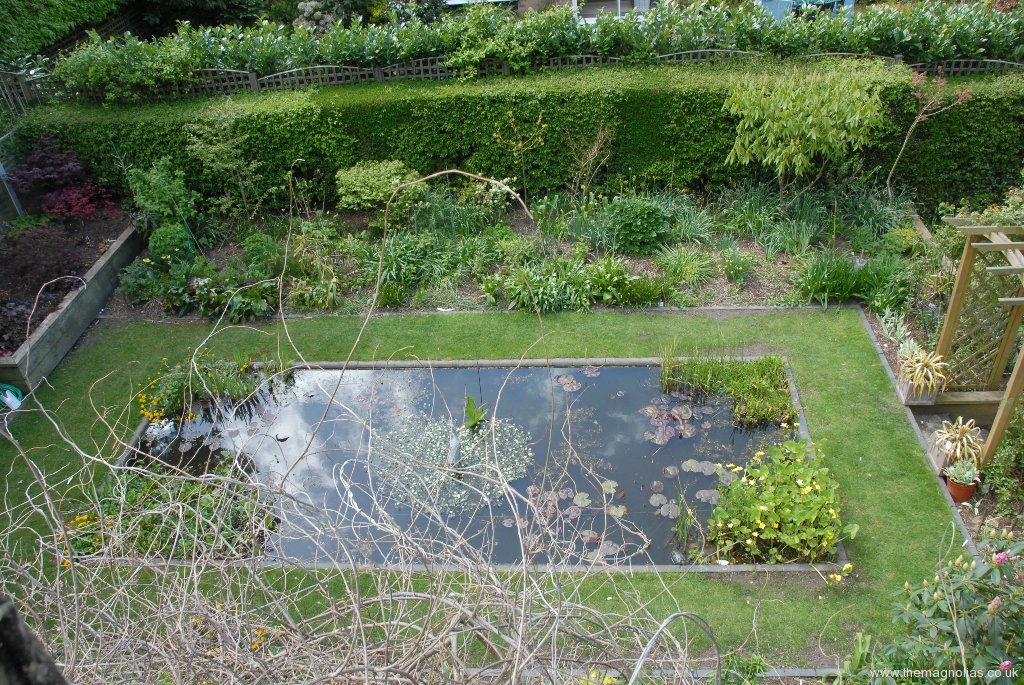
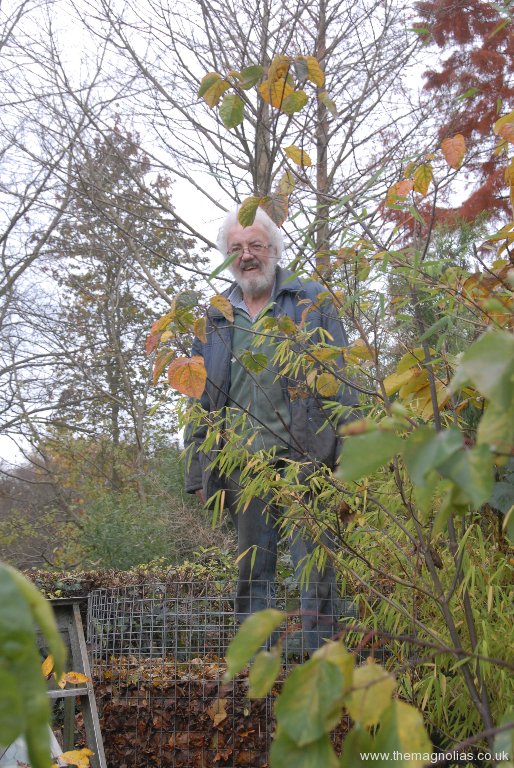
I have taken the opportunity of the ladder up the second pear tree, to take some never to be repeated aerial images.

The shredding of the tangled mass of Celastrus has been a fairly awful task and digging out the roots is hard work as they have been burried over the years with two feet of soil. Therefore two foot plus has to be dug away before you reach any roots to be cut.


More Wildlife

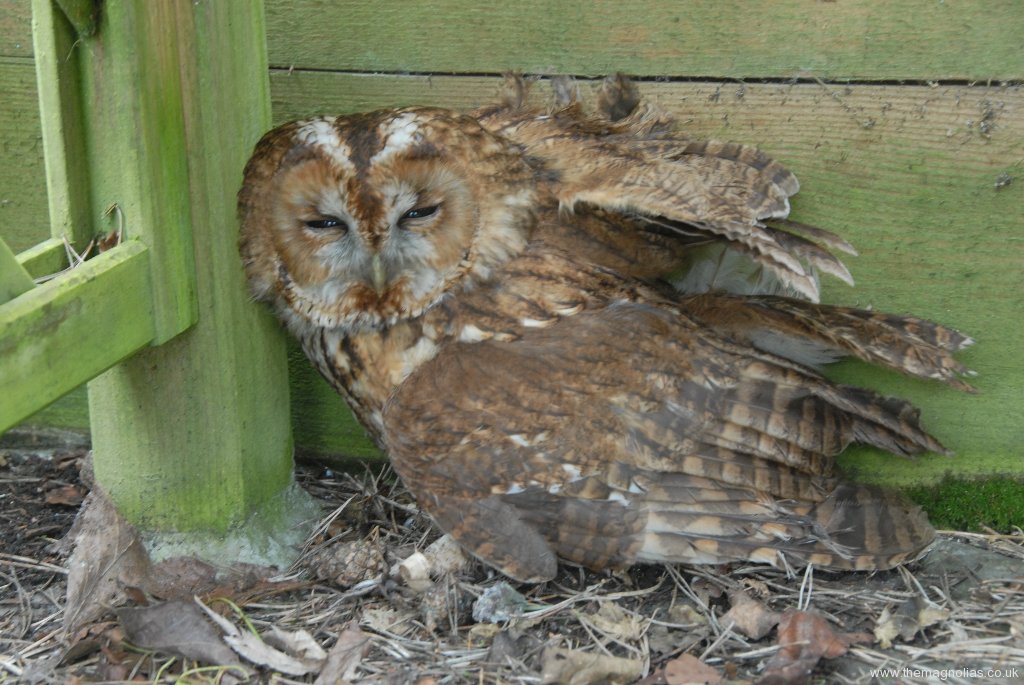
A little while ago we came across an unfortunate Tawny Owl which had got itself entangled in the single strand of fishing line, strung around the waterlily pond to try and deter the heron from taking our frogs or Golden Rudd.

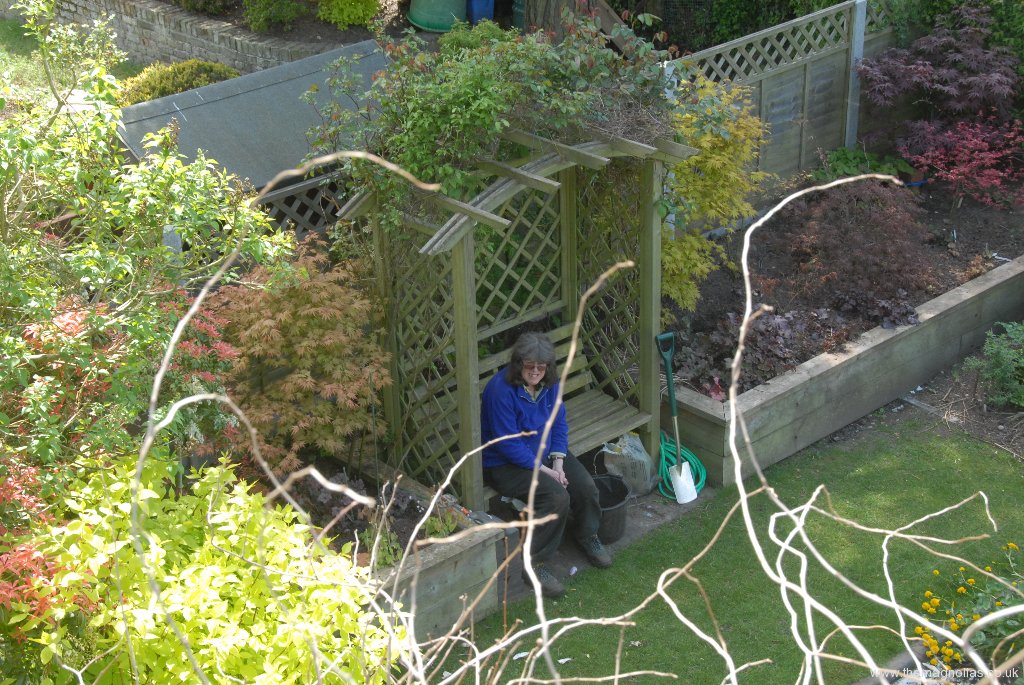
I cut the line and removed it from the bird’s wing, but it was clearly stressed and exhausted from its struggles, but otherwise unhurt. It couldn’t or wouldn’t fly when released but fluttered under our arbour seat. Worried that it might be spotted by a neighbour’s cat or a fox, we picked it up again and put it up a tree. It stayed there several hours but eventually disappeared. Not finding any feathers in the vicinity we are optimistic it must have eventually summoned up the strength to fly home.

Earlier this week much to my amazement I saw a Muntjac Deer in one of our neighbour’s gardens. It ran off when it saw me. I have been panicking that it may take up residence in the area and many precious plants may be browsed. I haven’t seen it again,
so hopefully it has returned to Hartswood, which is only a few hundred yards away as the crow flies.

Getting Soft in Our Old Age? (Part 2 Sword Tales!)

Happy New Year reader.

What a beautiful day for New Year’s Day 2013. The sunshine drew us outside to make a start on mulching our perennial and rose beds, with our own homemade compost. In two sessions today we have completed about half the job.

Anyway, back to the second half of the aquarium story. This time instead of asian tanks it is South American ones, or at least mostly from the Amazon area.

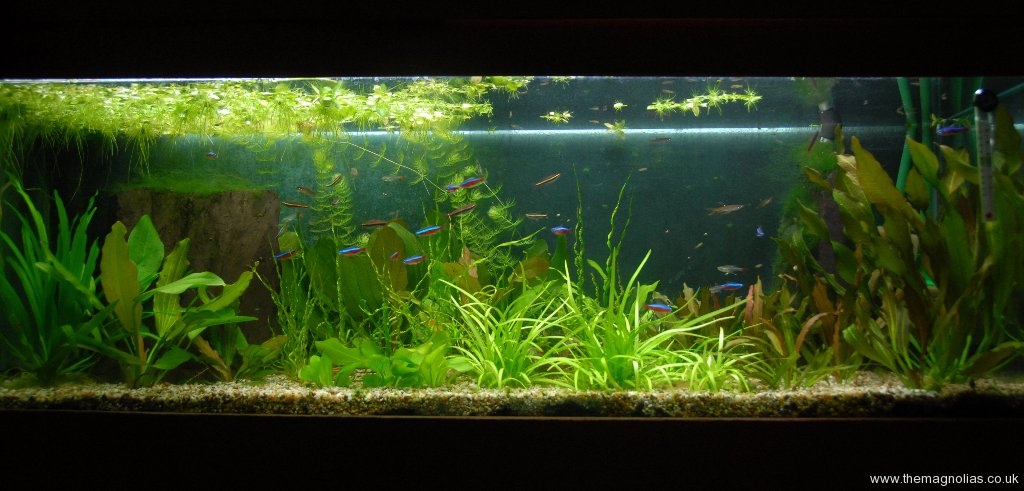
For quite a few years we have been running a fairly purist, four foot aquarium planted with Echinodorus or Amazon Sword Plants and a few other plants from the region. The tank is stocked with fish from the same area, including Engler type Guppies and various Characin species including several Tetras, Cardinal Tetras being in the greatest number. Amazon sword plants tend to need more light than Cryptocoryne species so we run three T8 fluorescent tubes. In addition they respond well to CO2 and feeding, producing colourful new leaves in succession.

This tank had suffered a bit from neglect over the 2012 three main gardening seasons, especially because the CO2 had not been kept going at times. We have now pulled it back fairly well.

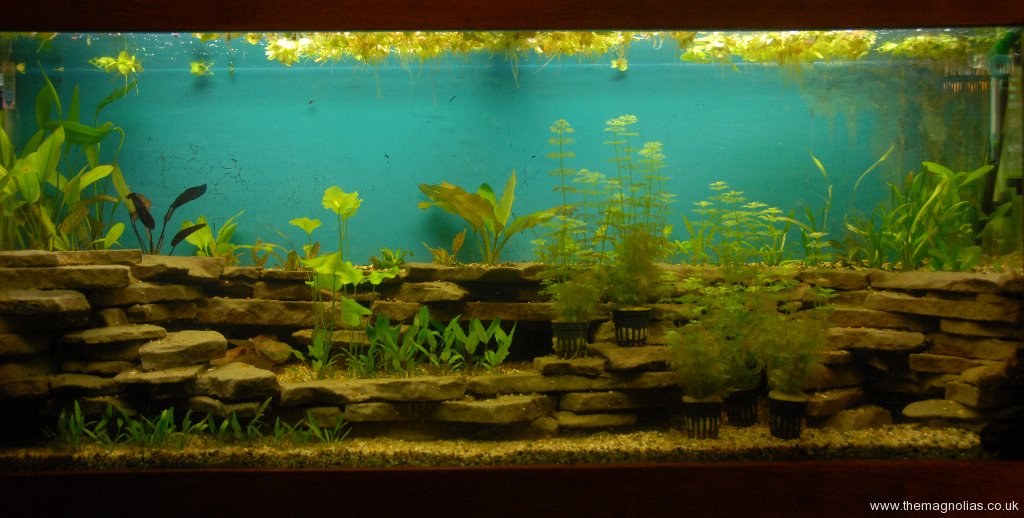
Our third big project of the winter has been an attempt to seal a five foot long, two foot deep aquarium that had been empty for at least five years following a hisory of leaking. The tank was built about forty five years ago and was quite unconventional. The bottom of the tank isĀ  a sheet of stainless steel, with the edges turned up at right-angles. Onto this has been welded a mild steel aquarium frame. It was then glazed with putty. The problem was the stainless steel base flexes easily if there is any movement in the base it is stood on.

The tank had been in two other peoples homes when I got it over forty years ago. I constructed what I thought was a sufficiently rigid stand and further sealed the bottom stainless steel to glass seams with melted tar. It was fairly well behaved for many years until we drained it following intolerable leaking. The problem of doing further work to the various glass to glass and metal seams was lack of access to some areas as large rock features were built into the design on its initial set up, here.

Following the two Crypt tank projects we cleaned out this tank of gravel and soil and then attempted to seal the seams which could be accessed, using more modern sealants. Normal aquarium silicon sealant was used glass to glass, vertical corners with a black mastic used on the glass to metal seams at the bottom. In order to have no glass lids between the lights and the water it was necessary to encase the mild steel top frame of the tank in strips of glass to protect it from rusting.

Above this is a hood constructed of 4mm mirror built onto a wood and hardboard frame, which is hinged onto the wall at the back and has counter balance weights on cables through pulleys to take the considerable weight of the mirrored hood.

The tank leaked rather worryingly for a day or two but further applications of mastic and resin adheasive to the outside combined with swelling of the ancient dried out putty and the water drips ceased.

I went on line again looking this time for Echinodorus and ordered quite a few exciting looking new ones. The tank has a long way to go especially before we can put any animals into it as it has been showing high levels of ammonia, nitrite and nitrate. This we think is because we used a quantity of recycled gravel which had been used as a substrate in a lizard tank. Although it was washed repeatedly it seems it wasn’t enough as the readings are exceedingly high. We are having to do daily partial water changes to lower the dangerous readings. After three daily, partial water changes the plants are looking happier at least!

I will post again when there is more to report on these projects.

Getting Soft in Our Old Age? (Part 1 Tales of the Crypts)

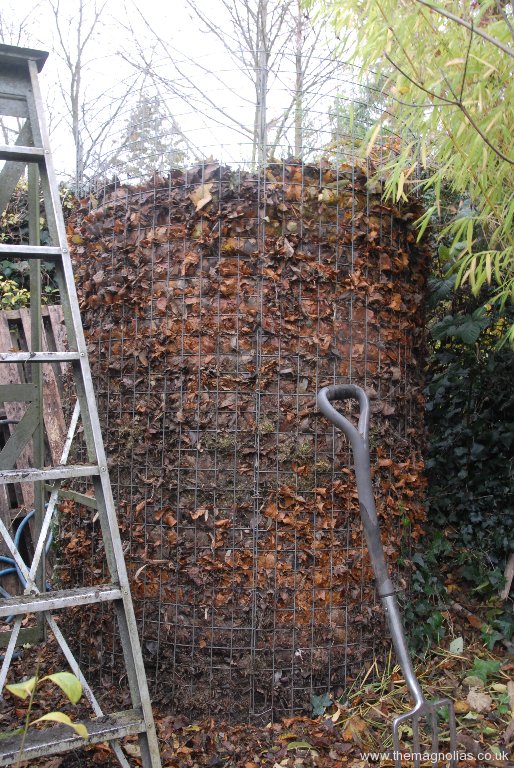
We haven’t fancied gardening much in the cold and damp, since finishing our leaf collecting. Besides the leaf tower is full anyway.

We have therefore done some intensive, indoor aquatic gardening, over the last few weeks.. I have kept tropical fish and aquarium plants for approximately fifty years continuously. However interest has waxed and wained, over the half century.

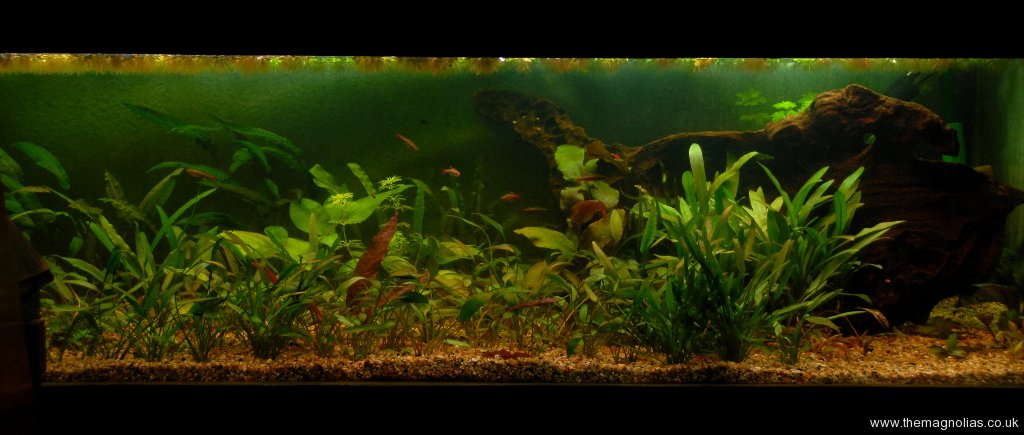
Linda suggested, when driven in doors in early November, that we do something else with an unheated tank with a huge filter running, and only one small, hardy Golden Rudd in it. The fish was put in the pond with its siblings and the tank emptied and cleaned. I have long been interested in a genus of tropical aroid plants called Cryptocoryne, some of which make slow growing and very attractive aquarium plants. We decided to make the tank into an Asian biotope, using Cryptocorynes almost exclusively.

We followed the advice of our close friend James, who owns and runs Wayside Aquatics, an immaculate bijou aquarium shop near us. He suggested we do a natural low-tech tank as a good way of growing Crypts, following the latest thinking. This involves a one inch layer of soil, low in organic matter, in the bottom of the tank. The ideal soil, apparently, is that produced by moles in their mole hills, or worm casts. Not having the patience to collect worm casts to cover an area of four square feet one inch deep, we searched out mole hills. We found some via another good friend, Mark, who is the gardener at Hutton Hall. He hadn’t seen any mole activity for months, but as if by magic, mole hills started appearing in the big lawn, there and then. He accused me of supernatural powers! Over the soil layer goes one inch of washed 2-3mm diameter gravel. Modest lighting was provided from one 1″ fluorescent tube and gentle circulation from one external Ehiem canister filter. A heater thermostat was added to maintain the tank at around 75°F .

Having set up the tank I was away, trawling the internet for Cryptocorynes. I ordered a sizeable collection from Germany, via eBay and others from three British online aquarium suppliers, as well as some bought straight from James. Would you believe it? – when they all arrived, I didn’t have room for them all, in the four foot tank.

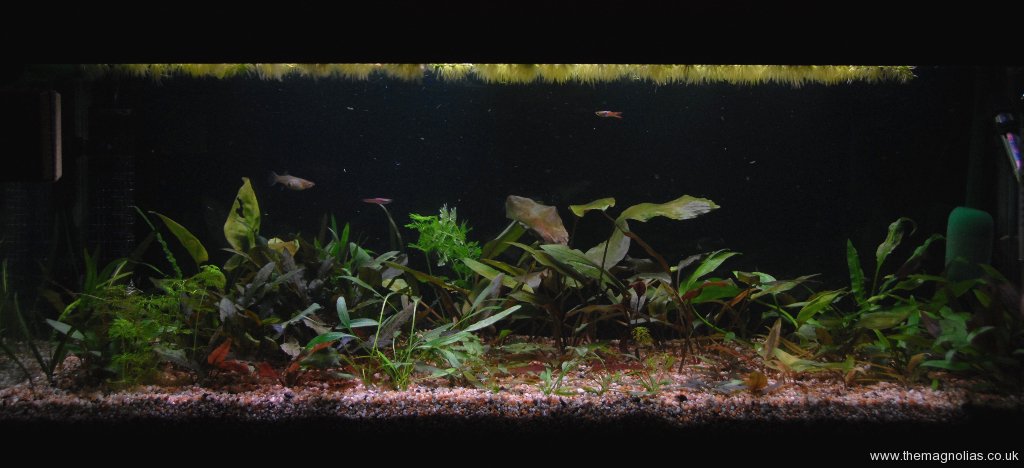
We quickly decided on a tank in our bedroom, which had been empty of anything but cold water, since it was last used for raising tree frogs to froglet stage. This tank was hastily cleaned and had the remainder of our mole hill soil topped up with Wickes’ top soil added, plus gravel,as before. This time, as an experiment, we decided to add a CO2 system, we had redundant from an earlier project. This way we could see if the growth was better or different with additional carbon.. This tank is only three foot long and also has one fluorescent tube lighting and a slightly smaller external Ehiem filter and a heater thermostat.

A few weeks have now elapsed and despite some of the Crypts doing their famous trick of leaf melt, the great majority are settling in and producing new leaves, albeit frustratingly slowly. Some of them had an excuse for behaving badly, having been up to four days in the post, during the colder period of our early winter, not ideal for sensitive tropical aquatic plants.

A few shrimps and fish have been introduced to each tank, having waited four weeks or so to allow the chemistry of the water to settle to a stable and safe condition. Longer was probably advisable but it’s hard not putting a few animals in new tank set ups. We now have to wait patiently for the plants to grow and hopefully create a delightful living picture.

Well done if you’ve read this far!

Linda and I wish visitors to our website a happy and healthy New Year.

Autumn Leaves – Red, Orange, Gold and Brown to be Turned Into Next Year’s Black Gold

“Don’t get me wrong, I love trees, but not in the street outside my house.The’re so messy with their leaves in the autumn.”

I heard this kind of statement on many occasions, from members of the public, when I worked in The London Borough of Havering, Council’s Parks Department. They have a point, but that mess is a fantastic resource for us keen gardeners.

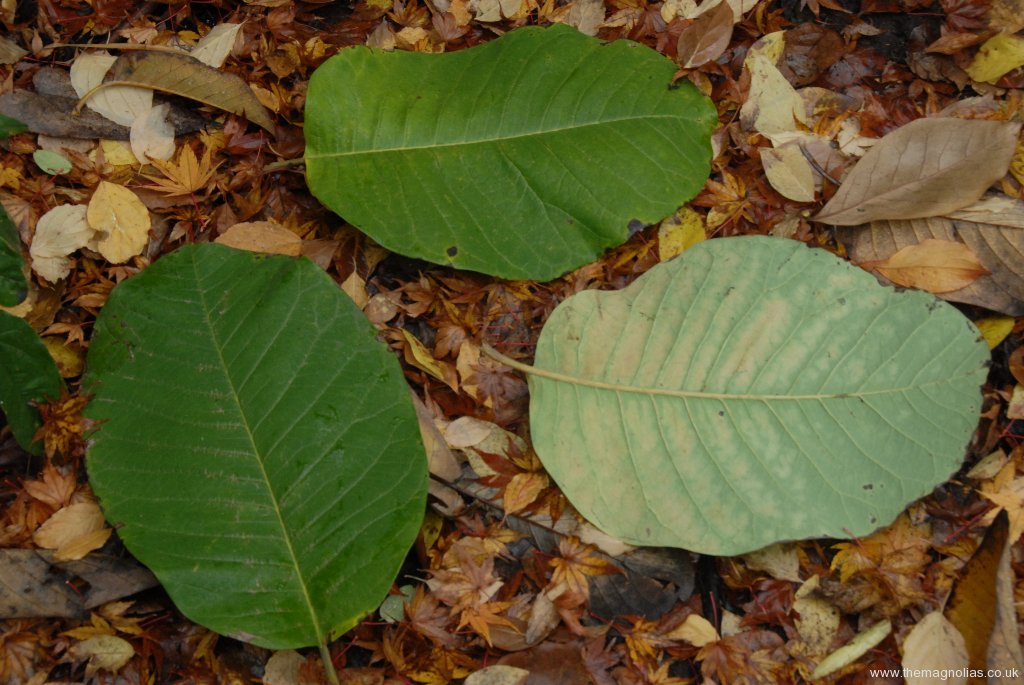
Linda and I collect not only our own leaves from our paths and grass areas, but also from a few neighbours’ front gardens and the verges, pavements and road gutters near our house. We pick them up using a rotary mower which partially shreds the leaves speeding the formation of leaf-mould.

We have a weld-mesh tower six feet high (1.8m) by four feet diameter (1.2m). We fill this each autumn and empty it a year later. When a year has elapsed it has reduced in volume to around half the height of the tower.

We spread the majority of this precious material around our Epimediums and other woodland plants, and over our Heuchera and Japanese Maple bed. Any left is put in bags to be used later for improving the soil for new plantings of woodland plants.

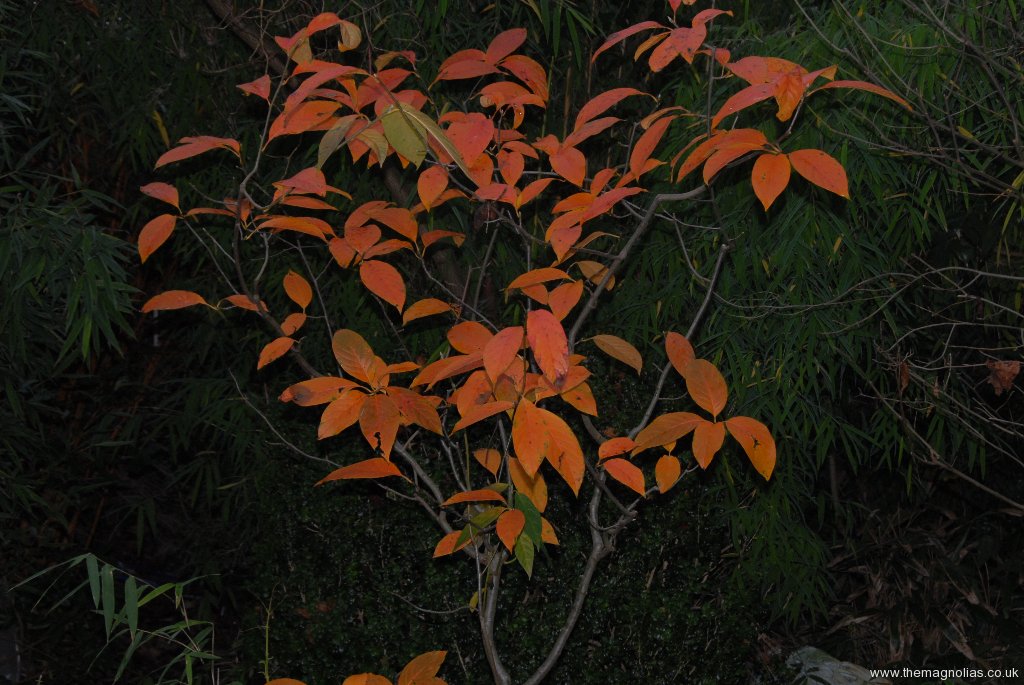
Autumn colouring trees and shrubs has long been a particular enthusiasm of mine.

However our garden doesn’t produce as good a performance from many plants as IĀ  have seen elsewhere. This is in part due, I think, to the soil. Ours is generally a good rich organic topsoil overlaying London Clay. Many subjects seem to be much more colourful in Autumn on poorer sandy soils. However some of our Japanese Maples are reliable, Acer palmatum ‘Osakazuki’ with its rich red and A.p. ‘Senga Kaku’ with bright yellow to orange. On the other hand our two Acer griseumsĀ  don’t produce the strong orange colours we’ve seen elsewhere and our large Acer rubrum ‘Scanlon, and Liquidambar styraciflua are a bit disappointing for the three dimensional spaces they occupy.

I have just posted a dozen or so new images of autumn colour in the ‘Shrubs Gallery’ many of which are off young Acer palmatum cultivars in pots.

By the way, having lost quite a few young Acer palmatums in pots left outside or in our unheated large greenhouse in winters past, I now always heel them in the ground over winter with no losses due to roots freezing. I think they become safer when they have grown large enough to be in a 3 gallon bucket sized pot and above. However ours is a sheltered garden in the South of England. It may be wise to protect sizable specimens in larger pots or tubs with bubble-wrap or fleece in winter time if severe weather is forecast. It is heart breaking to loose a maple of significant stature.

Summer, What Summer?

I don’t know about other British gardeners, but I feel a bit cheated by our 2012 Summer.

The only good thing about it was not having to water so much, especially with our large number of plants in pots. The bad things were far more numerous, not least of all the plague of slugs of biblical proportions, but then I’ve already ranted about them twice before.

Our Eremurus, so good in the last couple of years, failed to flower at all.

We had no apples on our two young but established trees, and the first cropping year of our Plum ‘Lizzie’ resulted in a great setting of fruit which all rotted before ripening. Too late to be much help, I found a site on The Net advocating the spraying of the fruits with a diluted solution of milk with a drop of washing up liquid, at regular intervals. I will try this next year, in good time if the summer is again a wet one.

We have lost two unusual small trees probably by drowning, a Styrax hemsleyana and a Cornus x rutgersensis. Also our honeymoon purchased, Magnolia campbellii has given us cause for concern, as it too may have suffered severe water-logging. There was a considerable leaf fall in August, carpeting the ground beneath the tree. However It kept perhaps half of its foliage and still has some now, so may be OK. It is now 37 years old and a good size and we’d hate to loose it.

Let’s hope next year is a more ‘typical British Summer’!

Half a Hundredweight of Slugs?

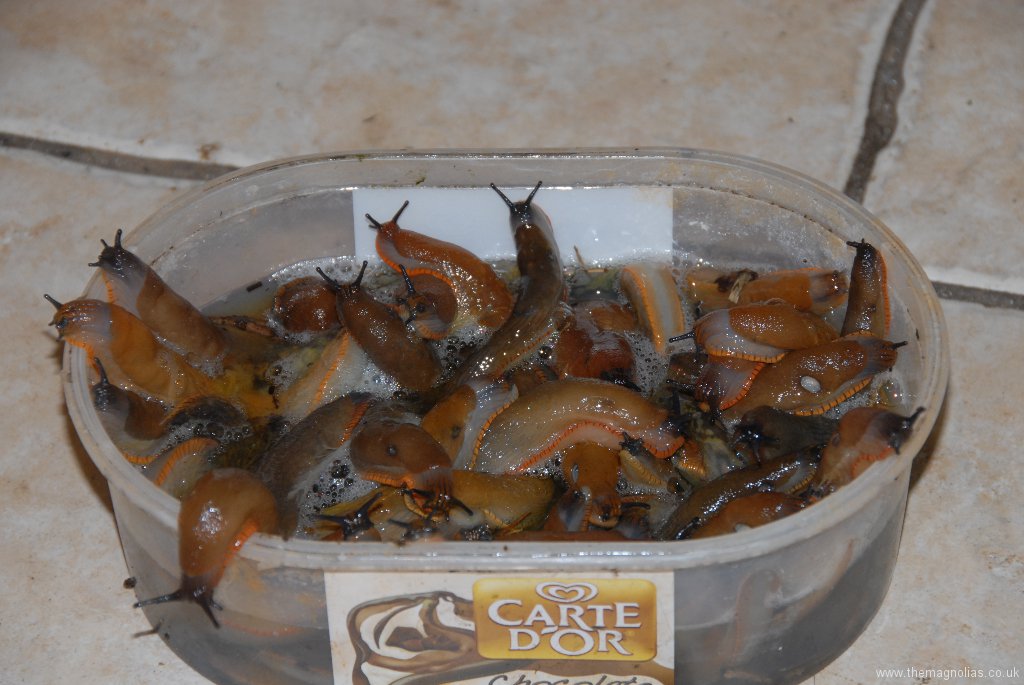
Last night, having collected a particularly impressive haul of slus, I decided to weigh them. I placed another ice cream box on top and tipped away the water.

I weighed the two bxes with slugs and without and the difference was a pound and a quarter. I’ve been collecting most nights since the Hostas started to sprout and have guessed at perhaps an average of eight ounces a night. This could mean I’ve destroyed over fifty pounds of slugs this year.

Despite collecting thousands of them I feel I still don’t understand slugs. There is a very large clump of Disporopsis pernyi and almost every night there are two or three large slugs in one small area of it feeding on its foliage, but not elsewhere in the plant. They have practically defoliated a Kirengeshoma plant in one spot and about twenty feet away another clump is almost untouched. I would love to know whether the ‘innocent’ orange slug feeding on pigeon or fox poo is the same species as the identical looking animals eating the Dahlias, Hostas etc.. Innocent or otherwise they have all met the same fate!